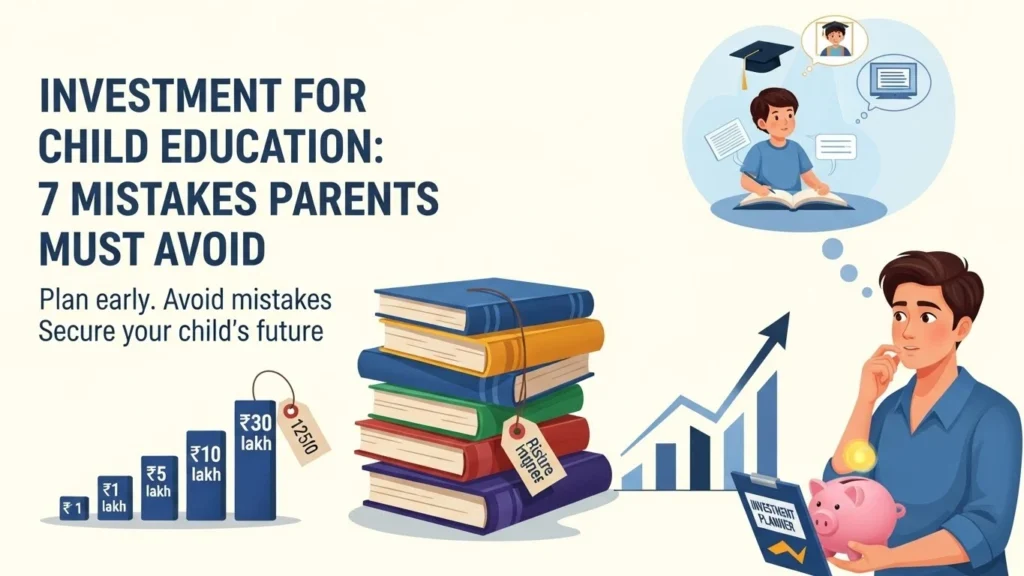
Investment for Child Education: 7 Mistakes Parents Must Avoid
“I remember my brother, who qualified for a medical entrance exam but couldn’t pursue his dream due to financial problems. This experience motivates me to plan investment for child education. When I became a father, my biggest concern was my child’s education. My son is currently in 4th grade, and I have already spent around ₹6 lakh on his education so far. He studies in a regular school, not an international one. This is an example of inflation in education. I’m sure you also worry about the rising education costs and want to provide the best education and career opportunities for your child.”
That’s why choosing the right investment for child education is so important. Yet many parents make the same common mistakes—leading to stress, under-saving, or choosing the wrong financial products. In this blog, we’ll uncover the 7 biggest mistakes parents must avoid, along with practical solutions, best investment options, and helpful comparisons. Whether you’re exploring the best child plan for education and marriage or looking for a trusted option like the SBI child plan for 5 years, this guide will make your planning easier and smarter.
Mistake 1: Starting Too Late
As a parent this is our first mistake toward Investment for Child Education. Time passes very quickly. Because of late investing, we face financial issues at the time of higher education. The education expenses rise much faster than normal inflation. School fees typically increase by 8–10% every year, and a college degree that costs ₹10 lakh today may cost ₹25–30 lakh in the next 10 years. A delay of even 1–2 years forces you to invest more each month to reach the same goal.
Why Starting Early Matters
| Monthly SIP | Investment Period | Total Invested | Estimated Corpus (12% return) |
| ₹5,000 | 20 years | ₹12 lakh | ₹48–50 lakh |
| ₹10,000 | 10 years | ₹12 lakh | ₹22–23 lakh |
The parent who starts 10 years earlier ends up with almost two times the corpus, even though they’ve invested the same amount. This difference happens because compounding needs time to work. The longer your money stays invested, the more it grows, helping you beat inflation and help your children to pursue their dream career.
Mistake 2: Choosing Only Safe, Low-Return Options
Many parents invest only in FDs, recurring deposits, or endowment plans because they feel these products are “safe.” But low returns of these product cannot beat education inflation. This is the 2nd mistake of Investment for Child Education.
If an FD gives 6% and education inflation is 9%, in this scenario your money is losing purchasing of it causing it you’re actually losing money slowly.
Best Investment for Child Education
For long-term goals, higher-growth tools work better:
- Equity mutual funds
- Hybrid mutual funds (my favourite)
- Child education plan for 10 years (SIP-based)
- PPF
These options grow faster and help you reach your target corpus comfortably
Mistake 3: Ignoring Long-Term Planning Horizons
Parents often invest without considering how much time they have before their child reaches higher education. Someone asked me to tell me a plan for their daughter’s higher education. I asked them about the time horizon first. This is the 3rd mistake of Investment for Child Education
Child Education Plan for 10 Years
A 10-year plan offers a balanced approach:
- Equity for growth
- Debt for stability
- SIPs that average out market ups and downs
Mistake 4: Choosing Insurance as the Only Solution
Most of the parents buy child insurance plans on suggestion of relatives or friends, thinking they’re perfect for education goals. While they offer safety and a mix of insurance and investment, they do not give high returns required to beat inflation. Always tried to avoid 4th mistake of Investment for Child Education
Better Approach
Use insurance for protection
Use investments for growth
You can combine:
- Term insurance for life cover of yourself not for your child.
- Mutual funds or hybrid plans for child education to grow money faster.
This strategy is more efficient and cost-effective.
Mistake 5: Not Comparing Different Child Investment Plans
Many Parents sometimes buy the first child plan offered to them without comparing features. Do not this mistake for Investment for Child Education.
Popular Options Parents Should Compare
- Equity mutual funds
- Hybrid mutual funds
- ULIPs
- Child education insurance plans
- SBI child plan for 5 years
- PPF
ULIPs are the combination of equity and insurance, therefore it gives very less return compared to other investment options.
Comparison Table: Best Investment Options for Child Education
| Investment Type | Risk | Ideal Duration | Returns | Best For |
| Equity Mutual Funds | High | 10–15 years | 12–15% | Long-term growth |
| Hybrid Funds | Medium | 5–10 years | 9–12% | Balanced approach |
| SBI Child Plan (5 years) | Low | 3–5 years | 6–7% | Short-term needs |
| ULIPs | Medium | 10+ years | 8–12% | Insurance + investment |
| PPF | Low | 15 years | 7–8% | Ultra-safe investors |
Choosing without comparison often leads to poor returns or mismatched expectations.
Mistake 6: Not Tracking Investments
We often think that simply buying an investment for child education is enough. Buying and forgetting your investments can hurt long-term goals, especially if the fund underperforms.
How to Stay on Track
- Review your portfolio once a year
- Rebalance if equity becomes too high or too low
- Switch funds if they underperform for 3+ years
This small step keeps your child’s education plan healthy.
Mistake 7: Underestimating the Future Cost of Education
Most of the Parents often make plans based on today’s education cost, not the inflation adjusted cost. We always ignore inflation.
Example:
- Present cost = ₹10 lakhs
- Inflation = 9%
- Duration = 10 years
Future Cost will be around. ₹24 lakhs. Therefore, it is advisable to make an investment plan for education for future costs including inflation. Relying on the present cost of education alone will increase financial stress in the future..
Best Child Plan for Education and Marriage
If you want a single plan for both education and marriage, choose options that offer:
- Long-term growth
- Flexibility
- Protection
Good choices include:
- Long-term equity funds (SIP)
- Hybrid funds
- Dedicated child investment plans
These help create a solid financial base for both milestones.
How Much Should You Invest?
To reach around ₹25 lakhs in 10 years, you need:
- SIP of ₹11,000–₹14,000 per month (assuming 12% return)
Starting early reduces your investment burden and increases your confidence.
FAQs on Investment for Child Education
1. What is the best investment for child education?
Equity mutual funds and hybrid funds are the best because they grow faster and beat education inflation.
2. What is a child education plan for 10 years?
It’s a medium-term investment strategy designed to build a strong education fund using SIPs, hybrid funds, or child education plans.
3. Is the SBI child plan for 5 years good?
Yes, it’s suitable for short-term needs—safe but with moderate returns.
4. How much should parents invest monthly?
For a ₹25–30 lakh goal in 10 years, a monthly SIP of ₹12,000–₹14,000 is ideal.
5. What is the best child plan for education and marriage?
A mix of long-term equity SIP + debt funds, PPF works best.
6. Should parents avoid fixed deposits for child education?
FDs are safe but cannot beat education inflation, so they shouldn’t be the main investment option.
7. How often should parents review their investment plan?
Once a year is enough to stay on track.
Conclusion
Planning the right investment for child education doesn’t have to be stressful. Once you understand the common mistakes—like starting late, choosing low-return products, ignoring inflation, or not comparing plans—you can make wiser decisions. Whether you choose equity mutual funds, hybrid funds, the key is to start early, invest consistently, and review your plan regularly. By avoiding these mistakes, you’re building a strong, stress-free financial future for your child